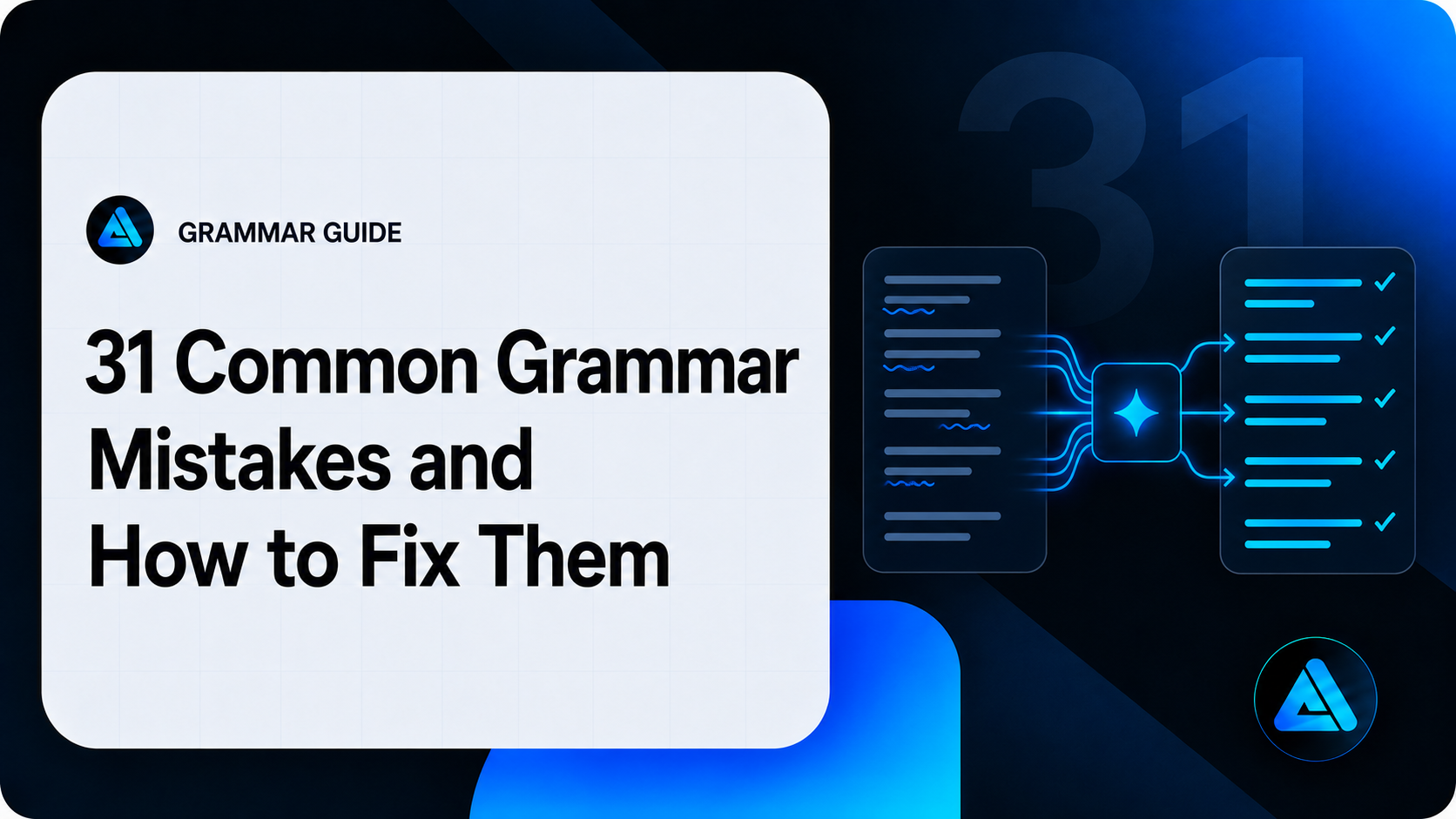
31 Common Grammar Mistakes and How to Fix Them
Let’s Be Honest — Grammar Trips Everyone Up
Let’s be real for a second — even the best writers mess up sometimes. Maybe it’s mixing up “your” and “you’re,” or hesitating over whether it’s “affect” or “effect.” It happens to all of us (yes, even the grammar nerds).
The truth is, grammar isn’t just about memorizing a bunch of rules. It’s more like rhythm when your words flow naturally, your ideas land better, and people actually want to keep reading. That’s what good grammar does. It connects, not corrects.
And let’s face it. We live in a time where we’re constantly writing something. A text here, an email there, a caption, a message. When you’re moving that fast, mistakes sneak in. A missing comma, an extra word, the wrong “their.” Totally normal. Writing is supposed to express, not stress.
But here’s the flip side. Those little slip-ups can still change how your writing feels. A small typo in a job email or a misplaced apostrophe in a post can make a big difference in how people read your words.
The good news? It’s not a big deal and it’s easy to fix once you know what to look for.
In this post, we’ll go over 31 of the most common grammar mistakes people make (and how to fix them fast or let Aissista, your AI writing buddy, clean them up for you).
So, whether you’re a student writing essays, a professional sending proposals, or someone who just wants their words to sound a little sharper. This one’s for you. Let’s smooth out the bumps and make your writing feel as confident as you are.
The Confusing Twins
Because some words just sound way too similar.
Honestly, English loves to mess with us. You think you’ve got it all figured out, and then boom, “your” and “you’re” show up looking almost identical but meaning completely different things. Don’t worry. These mix-ups happen to everyone. Here’s a quick, no-stress guide to keep them straight (and how Aissista can catch them for you before anyone else does).
1. Your vs. You’re
Wrong: Your amazing.
Fix: You’re amazing.
Quick Tip: “You’re” always means you are. If you can replace it with “you are” and it still makes sense, that’s your clue.
Example: You’re incredible = You are incredible. Works perfectly.
Aissista Insight: It spots this in seconds. So, you don’t have to double-check every sentence.
2. It’s vs. Its
Wrong: The dog wagged it’s tail.
Fix: The dog wagged its tail.
Remember:
It’s = it is or it has
Its = belongs to it
If you can’t replace it with “it is,” skip the apostrophe.
Example: It’s raining outside / The cat licked its paw
Aissista Insight: Think of it as your built-in grammar guardrail — no stray apostrophes allowed.
3. Their / There / They’re
Wrong: There going to love this.
Fix: They’re going to love this.
Here’s the quick cheat:
Their = ownership (their house)
There = a place (over there!)
They’re = they are
Aissista Insight: Detects these instantly. Because let’s be real, even professionals mix them up when typing fast.
4. Then vs. Than
Wrong: She’s taller then me.
Fix: She’s taller than me.
Quick Rule:
Then = time or sequence (first we ate, then we left)
Than = comparison (better than before)
Aissista Insight: Picks the right one for you based on your sentence. No guesswork, no grammar guilt.
5. Affect vs. Effect
This one’s the ultimate brain teaser.
Affect = verb (to influence)
Effect = noun (the result)
Example:
The weather affects my mood.
The effect is real, I get sleepy when it rains.
Aissista Insight: Knows when you mean action (affect) or outcome (effect), and fixes it quietly in the background.
Why These Matter
Tiny mix-ups can make your message feel careless. Even when your idea is solid. Knowing the difference (or letting Aissista know for you) keeps your writing sharp, clear, and confident. Because in the end, communication isn’t about being perfect. It’s about being understood.
Sentence Slip-Ups
Because grammar isn’t just words. It’s structure.
You can choose all the right words, but if your sentence structure goes off track, even the best ideas lose their spark. Think of grammar like building blocks. When they’re stacked right, your message stands tall. When they’re not, things start to wobble.
It happens to everyone. You write a great sentence, then realize something feels off. Maybe it’s too short, too long, or just… confusing. Don’t worry. These are common hiccups, and once you spot them, they’re easy to fix. Let’s walk through a few everyday sentence slip-ups (and how Aissista helps you catch them before they trip you up).
1. Sentence Fragments
Wrong: Because I was tired.
Fix: I went home because I was tired.
Sometimes we stop mid-thought without realizing it. A fragment sounds fine in your head but feels unfinished on paper. It’s like watching a movie trailer and never seeing the full film. You're left waiting for more.
Aissista Insight: Spots incomplete thoughts right away and helps you turn them into full, natural sentences without losing your tone.
2. Run-on Sentences
Wrong: I love writing it’s fun it helps me think.
Fix: I love writing because it helps me think.
We’ve all done this, got a burst of ideas and tried to fit them all in one breath. The result? A sentence that runs faster than your thoughts. Run-ons make your writing hard to follow and your message lose its rhythm.
Aissista Insight: Shows you where to pause, connect, or split sentences so your ideas flow clearly. No grammar traffic jams.
3. Comma Splices
Wrong: I studied hard, I still failed.
Fix: I studied hard, but I still failed.
A comma can do a lot, but it can’t hold two full sentences together. This mistake is sneaky. It looks small but makes your writing sound off-balance. Just add a conjunction (but, and, so) or a period, and you’re good to go.
Aissista Insight: Instantly catches these slips and gives you smooth, natural fixes that keep your tone intact.
4. Misplaced Modifiers
Wrong: Running to class, the rain soaked my notes.
Fix: Running to class, I got my notes soaked by the rain.
This one’s tricky. When modifiers are misplaced, your sentence accidentally says something you didn’t mean like the rain suddenly developed legs and ran to class. Modifiers work best when they sit right next to the word they’re describing.
Aissista Insight: Gently reorganizes sentences so your meaning comes across exactly how you intended. clear, direct, and human.
5. Double Negatives
Wrong: I don’t need no help.
Fix: I don’t need any help.
Double negatives sound casual in speech but confusing in writing. When you say “I don’t need no help,” the two negatives cancel each other out. Basically saying the opposite of what you mean.
Aissista Insight: Fixes these little mix-ups in seconds, keeping your writing confident and easy to read.
Why Sentence Structure Matters
Good writing isn’t about being perfect, it's about being clear. One misplaced comma or missing word can change the entire tone of your message. But when your sentences are strong and balanced, your ideas stand out effortlessly.
That’s where Aissista comes in. It doesn’t just correct your grammar — it helps you learn the rhythm of good writing. And the more you use it, the more natural it becomes. Eventually, you won’t just sound polished. You'll be polished.
Apostrophes, Plurals & Possession
Tiny marks, big meaning.
It’s wild how one little apostrophe can change everything. Add it in the wrong spot, and suddenly your “apples for sale” turns into “apple’s for sale” which sounds like one lonely apple owning something.
Apostrophes might look simple, but they carry a lot of weight. They decide whether something belongs to someone or is just more than one. The difference between “its” and “it’s,” or “students” and “student’s,” can completely change your sentence and sometimes your grade or professional tone.
Let’s break down a few of the most common mix-ups that trip writers up every day (and how Aissista keeps your apostrophes exactly where they should be).
1. Using Apostrophes for Plurals
Wrong: Apple’s for sale.
Fix: Apples for sale.
This is one of the easiest mistakes to make, adding an apostrophe where you just need an “s.” An apostrophe never makes something plural. It shows ownership or a contraction, not quantity.
Aissista Insight: Gently flags this error and suggests the correct form instantly, so you never sell “apple’s” again.
2. Plural vs. Possessive Mix-Up
Wrong: The teacher’s are nice.
Fix: The teachers are nice.
Adding an apostrophe here turns a group of teachers into one teacher owning something. If you mean “many teachers,” no apostrophe needed. Think of it this way — apostrophes don’t do group work.
Aissista Insight: Spots when you’ve added unnecessary apostrophes and corrects them without changing your meaning.
3. Its vs. It’s (Yes, Again — Because Everyone Forgets)
We’ve seen this one before, but it’s worth repeating because it trips up even the best writers.
It’s means it is or it has.
Its shows ownership.
Example:
Wrong: The dog wagged it’s tail.
Right: The dog wagged its tail.
Aissista Insight: Automatically detects when “it’s” doesn’t make sense and fixes it quietly in the background. No red squiggles, no confusion.
4. Who’s vs. Whose
Wrong: Whose coming to class?
Fix: Who’s coming to class?
This one’s sneaky because both look right at a glance. “Who’s” means who is. “Whose” shows possession.
Example:
Who’s ready for lunch?
Whose notebook is this?
Aissista Insight: Instantly identifies which version you meant and adjusts it automatically, so your questions always sound confident.
5. Students’ vs. Student’s
This one’s all about how many people own something.
Students’ → something belongs to many students.
Student’s → something belongs to one student.
Example:
The students’ projects were displayed in the hall.
The student’s project won first place.
A small apostrophe, a big difference in meaning.
Aissista Insight: Keeps track of these plural vs. singular ownerships so your writing sounds polished, precise, and professional.
Why Apostrophes Deserve More Respect
Apostrophes might be tiny, but they’re mighty. One misplaced mark can flip your meaning, confuse your reader, or make your message sound careless. The best part? You don’t need to memorize every rule. With Aissista by your side, you get instant corrections. And subtle guidance that helps you learn as you go. Over time, you’ll start catching these yourself, without even thinking about it. Because good grammar isn’t just about being correct. It’s about being clear, confident, and understood.
Tense & Agreement
Consistency keeps your writing clear.
If grammar is the structure of language, tense is the timeline. It tells your reader when things happen, yesterday, today, or tomorrow and whether your subject is doing the action or receiving it. Get it wrong and your sentence feels off, even if the words are right.
Tense and agreement mistakes are sneaky. They don’t always scream “wrong,” but they quietly make your writing sound unpolished. The goal? Keep your verbs in sync with your subjects and your timeframes consistent like a story that never skips a beat.
Let’s look at a few of the most common tense and agreement slip-ups (and how Aissista helps you keep every verb on track).
1. Subject–Verb Agreement
Wrong: She walk every day.
Fix: She walks every day.
Every sentence is a team effort. The subject and the verb have to agree on the plan. If your subject is singular (“she”), your verb should match (“walks”). Plural subjects get plural verbs (“They walk”).
Aissista Insight: Instantly detects mismatched subjects and verbs, even in long or complex sentences, and smooths them out so your writing always sounds natural.
2. Tense Confusion
Wrong: I am going yesterday.
Fix: I went yesterday.
Mixing timeframes is one of the most common grammar slips. We’ve all done it. You start in the present tense, end up in the past, and the sentence feels like a time traveler.
Aissista Insight: Gently spots tense shifts that don’t belong and adjusts them for consistency. So your writing stays on one timeline, unless you mean to jump between them.
3. Irregular Verb Mix-ups
Wrong: I have went to class.
Fix: I have gone to class.
Ah, irregular verbs. The rebels of English. They don’t follow patterns, so you just have to know them. Words like go/went/gone, eat/ate/eaten, and run/ran/run can trip up even seasoned writers.
Aissista Insight: Recognizes irregular verb patterns instantly and corrects them with the right tense form, no memorizing long grammar lists required.
4. Staying Consistent in Tense
Jumping between tenses mid-paragraph can make your reader stop and wonder when something actually happened.
Example:
Wrong: I was walking down the street and see my friend.
Right: I was walking down the street and saw my friend.
If you start in the past, stay there (unless you intentionally switch for effect).
Aissista Insight: Flags tense shifts that might confuse your reader and suggests smoother transitions, helping your writing sound clear and cohesive.
5. Using “Were” vs. “Was” in Hypotheticals
Example: If I were you, I’d try Aissista.
This one’s subtle but powerful. When talking about imaginary or hypothetical situations, “were” is used instead of “was.” It’s called the subjunctive mood and yes, that sounds fancy, but you use it all the time.
Examples:
If I were taller, I’d play basketball.
If it were sunny, we’d go out.
Aissista Insight: Catches these nuanced grammar moments and fixes them automatically, so your writing sounds polished and precise without you having to remember the term “subjunctive mood.”
Why Consistency Matters
Consistency is what keeps your writing smooth and easy to follow. When your verbs agree and your tenses line up, your ideas flow effortlessly from one sentence to the next. Readers stay focused on your message, not your mistakes.
And here’s the bonus: the more you write with Aissista, the more naturally consistent your grammar becomes. It’s not just correcting you. It's training your ear to feel what sounds right. Because good writing isn’t about following rigid rules. It's about clarity, rhythm, and confidence in every line.
Punctuation Power-Ups
Small marks that change everything.
Punctuation is the rhythm section of your writing, the quiet background that makes everything else sound right. A single comma can save you from confusion, and one extra exclamation mark can totally change your vibe.
Think of it like this: punctuation isn’t just a bunch of rules your English teacher drilled into you. It’s how you guide your reader through your thoughts, when to pause, when to smile, when to stop. A small mark can make your message sound confident instead of chaotic.
Let’s go over a few tiny-but-mighty punctuation fixes that even experienced writers miss sometimes and see how Aissista helps keep your writing balanced and natural.
1. The Oxford Comma Confusion
Example: I love my parents, Aissista, and grammar.
That last comma before and might seem optional, but it’s actually a life-saver. Without it, your sentence can take on a weird new meaning.
Without Oxford Comma: I love my parents, Aissista and grammar.
(So… your parents are Aissista and grammar? That’s awkward.)
The Oxford comma keeps things neat, clear, and impossible to misread.
Aissista Insight: Spots places where a missing comma might ca use confusion — and adds it only when it makes your writing easier to read.
2. Overusing Exclamation Marks!!!
We get it — you’re excited! But when everything ends with an exclamation mark, nothing feels exciting anymore.
Better: I’m so excited to share this with you!
Too much: I’m so excited to share this with you!!!!
One exclamation mark is all you need to show genuine energy. Let your words do the talking, not your punctuation.
Aissista Insight: Helps you find that sweet spot between expressive and excessive keeping your tone lively but still professional.
3. Quotation Mark Placement
This one’s small but surprisingly common. In American English, commas and periods go inside quotation marks.
Correct: She said, “I love writing.”
Incorrect: She said, “I love writing”.
In British English, it’s often the opposite but if you’re writing for the web or international readers, the American way keeps your writing consistent.
Aissista Insight: Automatically adjusts punctuation placement depending on your writing style and region, so you don’t have to memorize grammar charts.
4. Colons vs. Semicolons
They look similar, but they serve very different purposes.
A colon (:) introduces something — a list, a reason, or an explanation.
Example: I have three favorite writing tools: Aissista, coffee, and silence.
A semicolon (;) connects two complete thoughts that are closely related.
Example: I write every morning; it’s when my ideas flow best.
Aissista Insight: Knows when to use each one and helps you connect ideas smoothly — so your writing feels smart, not stiff.
5. Ellipses Misuse…
Ellipses (…) are fun — they create suspense or a thoughtful pause. But if you sprinkle them everywhere, your writing can start to feel scattered.
Use this: I was about to reply… but then I changed my mind.
Not this: I was… thinking… maybe… we… should… go…
And yes, it’s always three dots, not four or five.
Aissista Insight: Keeps your pauses intentional and balanced so your writing flows naturally without losing emotion.
Why Punctuation Matters
Good punctuation isn’t about perfection. It’s about clarity. It tells your reader when to pause, what to emphasize, and how to feel your words. Used right, punctuation turns plain sentences into a voice that sounds uniquely yours. And that’s what Aissista helps you do — not just fix the marks, but find your flow.
Because sometimes, the smallest details make the biggest difference.
Word Choice & Style
Because clear writing > fancy writing.
Big words don’t always make great writing, clarity does. You can have a brilliant idea, but if your word choice muddles the message, your readers will tune out halfway through. The goal isn’t to sound smarter; it’s to sound understood.
Think of your words like ingredients. You don’t need rare spices to make something delicious, you just need to use the right ones, in the right amount. Here’s how to make your writing cleaner, sharper, and easier to connect with.
1. Using “Literally” Incorrectly
Wrong: I literally died laughing.
Fix: I laughed so hard I almost cried.
We’ve all done this, dropped a “literally” to add drama. But unless you actually died (which would make writing tough), it’s best to use it only when you mean it.
Aissista Insight: Detects when “literally” is used figuratively and suggests more natural alternatives that sound expressive, not exaggerated.
2. Overusing Filler Words (like, really, very)
You know those little words we sprinkle everywhere “really,” “very,” “like”? They often sneak in when we’re thinking out loud. But on paper, they can water down your sentences.
Example: It’s a very beautiful day. → It’s a beautiful day.
Example: I was like, totally shocked. → I was shocked.
Cutting the fillers makes your message stronger, more confident, and easier to read.
Aissista Insight: Highlights filler words that weaken your sentences and helps you rewrite them with cleaner impact, without losing your natural tone.
3. Using “Less” vs. “Fewer”
A classic confusion. They both talk about the amount, but they’re not twins.
Fewer = for things you can count.
Example: Fewer books, fewer cars, fewer meetings.Less = for things you can’t count.
Example: Less water, less time, less stress.
Aissista Insight: Catches these subtle mix-ups in real time so your grammar sounds effortlessly correct, even when you’re writing fast.
4. Using “That” vs. “Which”
They might look similar, but they change the sentence meaning.
That gives essential information, the kind you can’t remove.
Example: The book that I borrowed was amazing.Which adds extra information, the kind you could take out.
Example: The book, which I borrowed yesterday, was amazing.
Aissista Insight: Suggests the right choice based on sentence flow so your meaning stays clear, not clunky.
5. Using “Good” vs. “Well”
This one’s about knowing what you’re describing.
Good is an adjective, it describes things or people.
Example: She’s a good writer.Well is an adverb. It describes how something is done.
Example: She writes well.
Aissista Insight: Notices when you’re mixing up adjectives and adverbs and polishes your tone automatically, so your writing sounds natural and polished.
Why Word Choice Matters
Words are powerful. The right ones make your writing sound confident and easy to follow; the wrong ones can make it sound forced or unclear.
Great writing isn’t about using the biggest vocabulary. It's about using the right words in the right way. And that’s exactly where Aissista steps in, helping you write like yourself, just sharper, smoother, and more focused. Because clear writing doesn’t just get read, it gets remembered.
Capitalization & Formatting
Honestly, even the best-written sentence can lose its shine if the formatting feels messy. Capital letters, proper names, title- these tiny details quietly shape how professional and polished your writing looks. And it’s not just about grammar; it’s about trust. A well-formatted email, essay, or post says to your reader,
“Hey, I care about what I’m saying — and about how you see it.”
So let’s fix a few common formatting slip-ups that even experienced writers make (and see how Aissista helps you catch them before anyone else does).
1. Random Capital Letters
Wrong: I met The Manager At The Office Today.
Fix: I met the manager at the office today.
Not every word needs a capital letter. Save those for the real stars. Proper nouns like names, places, or days. Everything else? Keep it lowercase and let your words flow naturally.
Aissista Insight: Automatically spots unnecessary capital letters and keeps your writing consistent. No more random words shouting for attention.
2. Forgetting to Capitalize Proper Nouns
Wrong: i love visiting new york in summer.
Fix: I love visiting New York in summer.
Names of people, cities, companies, and days deserve capital letters. It’s such a small thing, but it instantly makes your writing look more thoughtful and credible.
Aissista Insight: Catches missed capitalizations and fixes them instantly — perfect for when you’re typing fast or multitasking.
3. Overusing ALL CAPS
Example: THIS IS IMPORTANT!!!
Yes, it grabs attention but it can also sound like someone’s yelling. Use all caps with intention: a short heading or one key word for emphasis.
Aissista Insight: Softens the overuse of all caps while keeping your message confident and clear. Assertive, not aggressive.
4. Title Case vs. Sentence Case Confusion
Knowing when to use Title Case (Capitalizing Each Word) or Sentence case (Only the first word) helps your writing stay clean and consistent.
5. Formatting for Readability
Ever opened an email that’s just one giant paragraph? Exhausting, right? Break things up. Add spacing, bullet points, or bold for clarity. Good formatting isn’t decoration — it’s design. It guides your reader through your message effortlessly.
Aissista Insight: Suggests cleaner paragraph spacing and layout tweaks that make your writing easier to read and nicer to look at.
Why Formatting Matters
People don’t always read your writing. They scan it. Capital letters, spacing, and structure help guide their eyes, making sure your message lands exactly the way you want. When your writing looks clean, it feels confident. And readers notice that. They trust it more.
That’s why Aissista doesn’t just fix your words. it polishes how they appear. Because smart writing should sound great and look great. At the end of the day, clean writing = clear thinking.
Grammar Is Just a Start — Clarity Is the Goal
The reality is, perfect grammar isn’t what makes great writing. You don’t need to memorize every rule or second-guess every comma. What matters most is clarity, the kind of writing that feels natural, connects with people, and gets your point across without confusion.
Even the best writers slip up sometimes. Typos happen. Tenses get tangled. That’s okay. What separates good writing from great writing isn’t perfection. It's how easily your words make sense to your reader. And that’s something anyone can improve with the right help.
That’s exactly why we created Aissista — your friendly AI writing partner that does more than fix grammar. It helps you organize your thoughts, polish your tone, and make your ideas flow smoothly. Whether you’re writing a blog post, an email, or a caption, Aissista helps you sound clear, confident, and completely you all in one click.
So stop worrying about every tiny grammar mistake. Focus on expressing what you really want to say. Let Aissista handle the cleanup while you bring the creativity.
Try Aissista today — the smarter way to write clearly, confidently, and effortlessly.